I'll research the SERP landscape before revising. Now let me confirm authoritative external sources and local regulatory pages.
Septic tank plumbing problems rarely announce themselves clearly, which is why so many homeowners pay for a pump-out that fixes nothing. The waste chain runs from your sink trap to the drainfield, and one boundary a few feet outside your foundation decides whether you need a plumber or a septic contractor. Here is how to tell the difference before you pick up the phone.
How Septic Tank Plumbing Works, End to End
Wastewater leaves a fixture, drops into a branch drain, merges into the main sewer line, enters the tank, separates, then flows out to the soil.
That path is the whole diagnostic map. Knowing it stops you from pumping a tank that didn't need pumping or snaking a line when the real fault is a saturated field.
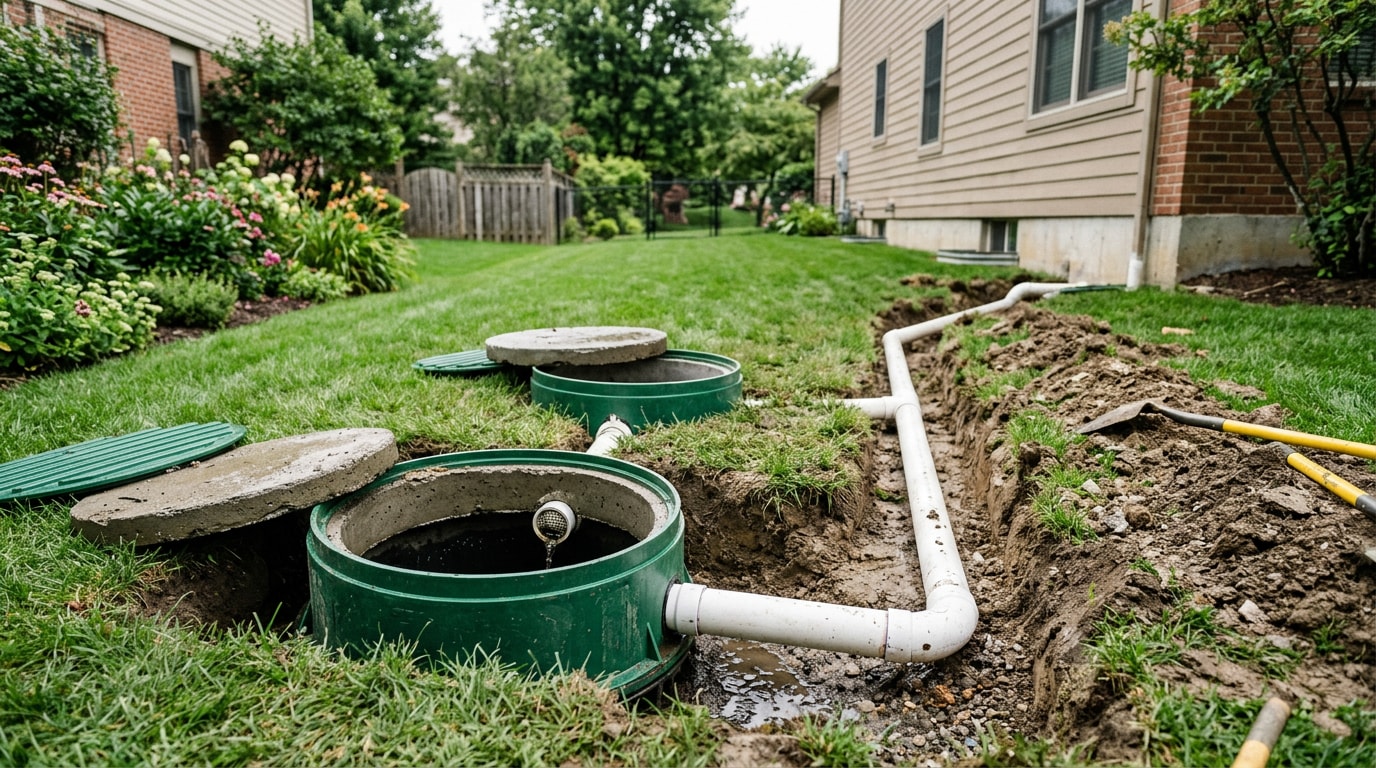
In a typical conventional system, all water runs out of your house through one main drainage pipe into a buried, watertight tank of concrete, fiberglass or polyethylene, which holds wastewater long enough for solids to settle into sludge and for oil and grease to float as scum, while compartments and a T-shaped outlet keep both from traveling into the drainfield.
The liquid, called effluent, is discharged into perforated pipes buried in a leach field or chambers that release it slowly into the soil, an area known as the drainfield.
The Handoff Point That Decides Everything
Plumbing and septic are two halves of one waste chain, not the same system.
Plumbing is the network of supply lines, fixtures, traps and vents in your home. It moves water in and wastewater out, but it treats nothing.
The septic system is the tank, drainfield and buried pipes that do the treating.
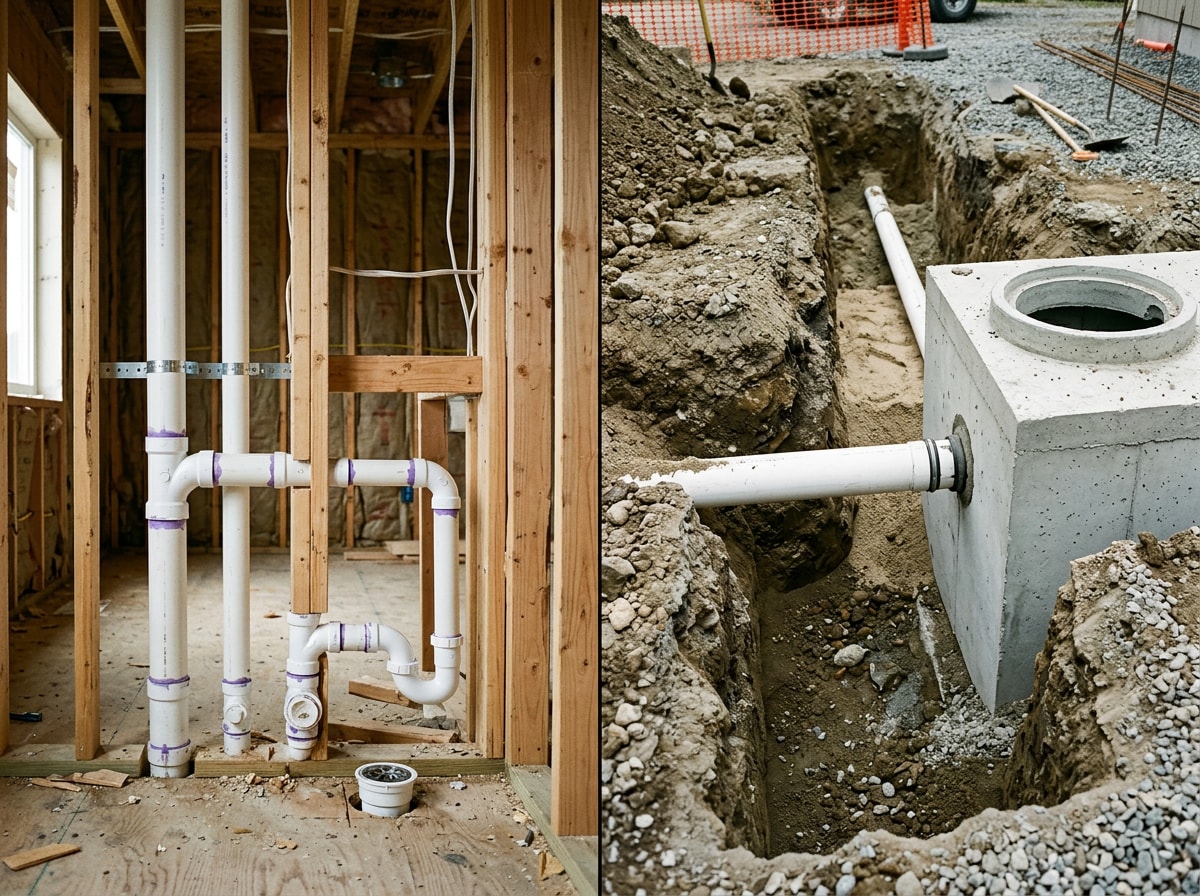
The handoff happens a few feet outside your foundation, where the main sewer line meets the tank's inlet. Upstream of that point is interior plumbing. Downstream is septic.
That boundary matters more than any symptom below, because it decides which licensed trade is allowed to touch the problem.
Components, in Order of Flow
Follow the chain: interior drain plumbing, main sewer line, inlet pipe and inlet baffle, tank, outlet baffle or effluent filter, outlet pipe, distribution box, drainfield.
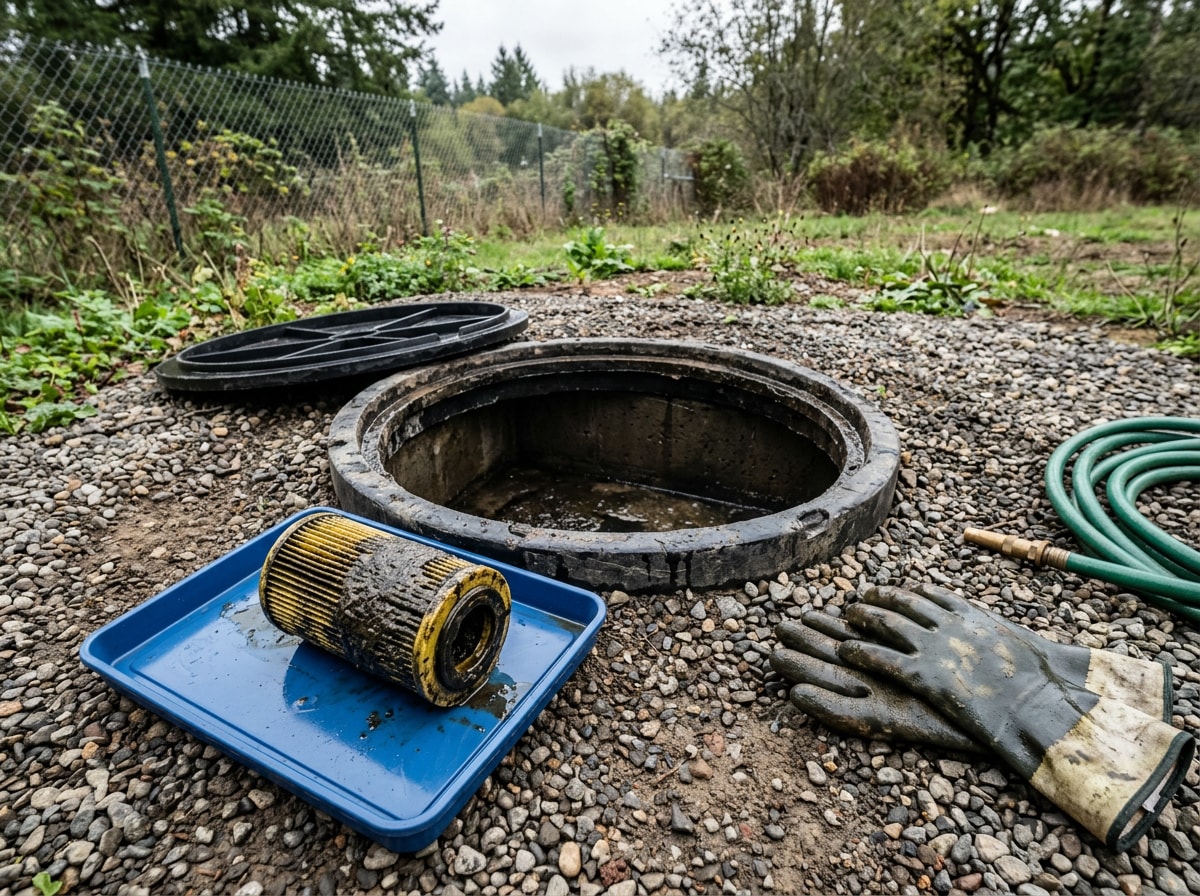
The baffles are simple T-shaped fittings doing unglamorous work. The inlet baffle keeps incoming flow from stirring up settled solids. The outlet baffle holds sludge and scum back so only clarified liquid reaches the soil.
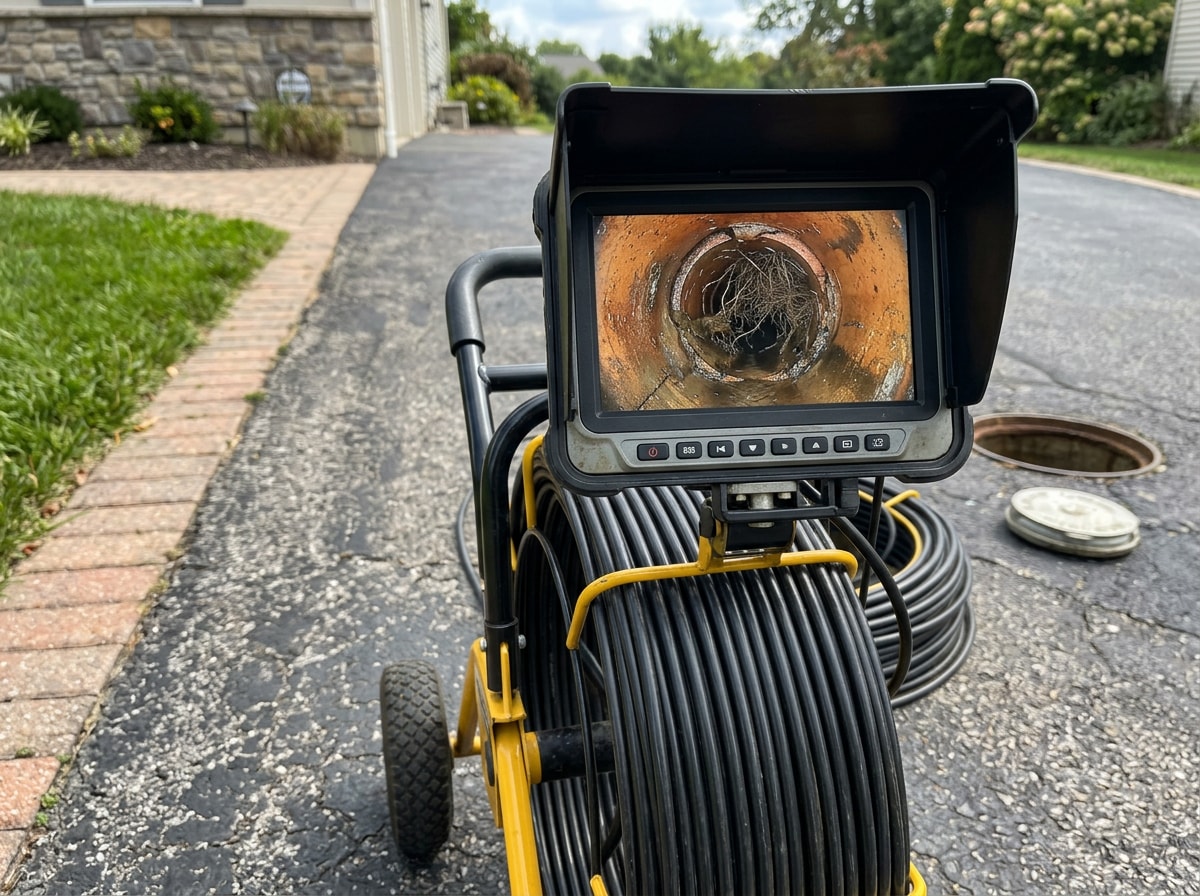
One component fails more than the rest: the main sewer line between the foundation and the tank. It is the longest unprotected run, it depends on consistent slope, and it is the piece roots find first.
Federal guidance on how conventional septic systems work describes this same sequence. For the buried portion of the chain, see our sewer and septic service) overview.
Vent Pipes: The Overlooked Half of Septic Plumbing
Drain lines need air to flow. The plumbing vent stack running up through your roof supplies it, letting air in behind draining water and gases out above the house.
When a vent gets blocked by a nest, debris or a crushed cap, the system pulls air from wherever it can, usually through the water in your traps. You get gurgling drains, slow flow with no clog anywhere, and sometimes a faint sewer gas odor indoors.
Here is the part that costs people money: a venting fault mimics a failing tank almost perfectly. Multiple drains act up at once, the homeowner books a pump-out, the truck leaves, and the gurgling comes right back.
Common Septic Tank Plumbing Problems and Their Causes
Most failures trace back to a short list.
- Roots enter the sewer line at joints, expand over several seasons, and eventually choke flow completely.
- Grease pours in as a liquid and sets as a solid, narrowing the pipe season after season.
- Wipes, paper towels and cat litter do not break down and snag on anything rough.
- An overdue tank lets solids escape past the outlet and plug the soil.
- Groundwater or roof runoff infiltrates the tank and floods the field.
Build-up of excessive scum or sludge in the tank causes solids to enter the soil treatment area and plug it over time , which is the slow-motion version of a failure most homeowners never see coming.
| Symptom | Most likely cause | Where it sits | Who to call | First diagnostic step |
|---|---|---|---|---|
| One fixture slow, others normal | Trap or branch-line clog | House side | Plumber | Auger the branch line |
| All drains slow at once | Clogged main line or full tank | Line or tank | Septic company first | Read liquid level at the tank |
| Bubbling pipes, no clog found | Blocked vent stack | House side (roof) | Plumber | Inspect vent from the roof |
| Backup after heavy rain | Field saturation or groundwater infiltration | Drainfield | Septic company | Field and tank inspection |
| Soggy ground or bright green grass over the field | Surfacing effluent, failing field | Drainfield | Septic company | Field evaluation |
| Odor near the tank, drains fine | Failed baffle, loose lid, vent fault | Tank | Septic company | Baffle and lid inspection |
| Odor indoors only | Dried-out floor drain trap or vent fault | House side | Plumber | Fill traps, check vent |
That last row is worth remembering. Odors inside a home typically indicate a plumbing problem, and a very common one is a basement or floor drain trap drying out and letting gases vent back into the house.
On service calls around Santa Clara County, the single most common misdiagnosis we see is a whole-house slowdown blamed on the tank: the homeowner pays for a pump-out, gets about three good weeks, then backs up again because roots had colonized a joint in the lateral and clearing the tank only bought temporary headroom.
Repair costs and pumping intervals vary widely by region, tank size and household load, so treat any number you read online as a starting point rather than a quote. If the fault looks like it sits in the line, our sewer line inspection page explains how the camera run works.
Is It a Plumbing Problem or a Septic Problem? A Three-Step Triage
Run these in order before you call anyone. They take about fifteen minutes and they change who you dial.
Step 1: the one-fixture test. Run a sink, then a tub, then flush a toilet on each level. One slow fixture means that fixture. Everything slow at once means the main line or the tank.
Step 2: the rain test. If drains only misbehave during or after heavy rain, suspect field saturation or groundwater entering the tank. Both are septic-side issues.
Step 3: the liquid level read. Look through an inspection port and compare the liquid level against the inlet and outlet pipes.
| What you see at the tank | What it means | Who to call |
|---|---|---|
| Level below the inlet pipe | Blockage between the house and the tank | Plumber |
| Level normal, right at the outlet invert | Tank is working; fault is upstream or at a fixture | Plumber |
| Level above the outlet pipe | Effluent is not leaving; field or outlet is the problem | Septic contractor |
| Level above the outlet plus standing water in the yard | Field failure or saturation | Septic contractor |
A tank is always "full" in normal operation, because every gallon in displaces a gallon out. A tank that looks full is not proof of anything. A tank that is over full is.
Safety first: never enter a septic tank and never wrestle a heavy lid off alone. Tank gases can be fatal within seconds and old lids can fail without warning. Read through an inspection port or have a professional open it.
If the triage points back at the house, request a free estimate and we will camera the line before anyone digs.
Plumber vs. Septic Company: Who Handles What
Licensing draws the line, not preference.
| Task | Plumber | Septic contractor |
|---|---|---|
| Fixture, trap and branch drain repair | Yes | No |
| Main sewer line between house and tank | Yes | Sometimes |
| Camera inspection of the lateral | Yes | Sometimes |
| Hydro jetting a blocked lateral | Yes | Sometimes |
| Tank pumping | No | Yes |
| Baffle and effluent filter service | No | Yes |
| Drainfield repair or replacement | No | Yes |
| Pre-sale septic inspection | No | Yes |
Call a Plumber When
- A single fixture drains slowly or backs up
- Water pressure drops, which is a supply-side issue unrelated to your septic system
- A toilet runs, leaks or will not flush cleanly
- You need a clog cleared or a trap rebuilt
- You suspect a break, belly or root intrusion between the foundation and the tank
- You want a camera inspection of the house-to-tank run
Those first calls usually start with main line drain cleaning or a straightforward plumbing repair. If sewage is already backing up into the house, that is an emergency plumbing service call, not a morning call.
Call a Septic Company When
- Multiple drains slow or back up together
- You smell sewage near the tank or field
- The tank is due for pumping or inspection
- Standing water or soggy ground appears over the field
- A septic alarm sounds or a pump fails
- You need a pre-sale inspection
One sequencing tip that saves money: if the system has not been serviced in years, start with the septic company. They will open the tank, read the levels, and tell you in minutes whether the fault is theirs or a plumber's.
Not sure which trade covers your address? Our guide to who to call first for septic plumbing walks through the vetting questions, and you can confirm coverage on our San Jose and surrounding areas, Los Gatos and Palo Alto pages.
Septic-Safe Plumbing Practices
Prevention is mostly about what you keep out of the system.
- Trash, not drain: wipes, paper towels, feminine products, cat litter, paint, solvents and harsh drain chemicals.
- Scrape grease into a can. It coats pipe walls and never leaves on its own.
- Keep vehicles, trailers and equipment off the tank and leaching bed. Compacted soil ruins absorption.
- Spread laundry across the week instead of running six loads on Saturday.
- Fix running toilets fast. A leaking flapper can add hundreds of gallons a day to a system sized for a fixed daily volume.
- Route water softener backwash out of the septic system if your local rules allow it. University of Maryland Extension advises against discharging water treatment backwash into a septic system.
- Stay on a pumping and effluent-filter schedule.
EPA guidance says the average household septic system should be inspected at least every three years by a septic service professional. In California, septic systems are regulated under a statewide policy with county health departments as the lead agency, so check the state OWTS program and your county for local pumping and permitting rules before scheduling work.
An annual plumbing inspection of the house side pairs well with that schedule, since most of what overloads a tank starts at a fixture.
FAQ
Can a regular plumber work on septic systems?
A licensed plumber handles interior plumbing and the sewer line up to the tank. Tank and drainfield work usually requires a separate septic license. Some contractors hold both. Licensing rules differ by state and county, so confirm scope before booking.
How do I know if my main sewer line is clogged or my septic tank is full?
Compare the liquid level inside the tank against the inlet and outlet pipes. A level below the inlet means the blockage is between the house and the tank, which is a plumber's job. A level above the outlet means effluent is not leaving the tank, which is a septic contractor's job.
How often should a septic tank be pumped?
University of Maryland Extension calls routine pumping the most important maintenance, generally every three to five years. Household size, tank size and garbage disposal use shift that interval, so ask your pumper to record sludge depth each visit and set the schedule from measurements.
What is the pipe coming out of the ground near my septic tank?
Usually a cleanout, an inspection port over a baffle, a riser access lid, or a vent. Cleanouts have a threaded cap at grade. Risers are wide with a bolted lid. Vents are narrow and either open or mushroom-capped. A vent should not produce ground-level odor unless something is wrong.
Can you snake a drain or use drain cleaner on a septic system?
Mechanical snaking and hydro jetting are fine, and jetting is often the better choice when grease or roots are the cause. Caustic and acid drain chemicals are not. They do not clear a root mass, and they end up in a tank that relies on living bacteria.
Is a garbage disposal bad for a septic tank?
It adds solids, which shortens the interval between pump-outs. If you use one, expect to pump more often and keep fibrous waste and grease out of it entirely.
Should I add bacteria to my septic system after plumbing work?
Generally no. University of Maryland Extension states it is not necessary to add enzymes or bacteria, because additives do not improve system performance. A healthy tank repopulates from normal household wastewater. Routine pumping does far more.
Does shower and laundry water go into the septic tank?
Yes. Every drain in the house, including showers, sinks and the washing machine, discharges to the same tank unless a separate greywater system was permitted and installed. That is why high-volume laundry days can push solids toward the field.
What are the early signs of septic system failure?
Slow drains across the house, gurgling, sewage odor outdoors, and pooling water or unusually lush grass over the tank or field. A foul odor is not always the first sign of a malfunctioning septic system , so treat whole-house slow drainage as the earliest reliable warning.
How much does septic plumbing repair cost?
It depends on whether the fault is a clog, a collapsed lateral, a failed baffle or a saturated field, and prices vary by region and access. Get the diagnosis first, in writing, then the estimate. Paying for a camera inspection before any excavation is almost always cheaper than guessing.
Get the Diagnosis Before the Dig
Most septic tank plumbing calls are solved by one question: is the fault upstream or downstream of the tank inlet? Run the three-step triage, read the liquid level, and call the trade that matches the answer.
If you are in San Jose, Sunnyvale or anywhere on the Peninsula and the line between your house and the tank is the suspect, Gomez Sewer & Drain can camera it, clear it and show you the footage. Request a free estimate and we will start with the diagnosis, not the shovel.
Written by the licensed service team at Gomez Sewer & Drain, plumbing and drain specialists serving San Jose, the South Bay and the Peninsula. Questions about your system? Reach us through our contact page.