Searching for an rv plumbing diagram Santa Clara, CA owners can actually follow usually means you're mid-leak, mid-winterizing checklist, or halfway through a DIY repair. This guide maps every component in an RV water system, shows you how to trace the schematic, and flags what Santa Clara's mild winters still mean for your lines.
What Is an RV Water System Diagram?
An RV water system diagram is a visual map of how water moves from its source to your fixtures and back out again. It traces the path from the fresh water tank through the pump, into the lines, and finally to the faucets, shower, and toilet.
Santa Clara RV owners pull up these diagrams for a few practical reasons: troubleshooting a drip before a weekend trip, winterizing ahead of a cold snap, or trying to understand a rig before attempting a repair solo. If a leak turns into standing water under the cabinets or a sewage smell in the coach, that's no longer a DIY project. Our emergency plumbing service covers those calls too.
Core Components of an RV Water System
Every RV plumbing layout is really three connected circuits: fresh water supply, hot water delivery, and wastewater removal. Each circuit has its own parts, but they all tie back to the same source and the same drain points. For a deeper look at how these circuits compare to a house's plumbing, our guide on plumbing systems and fitting specs breaks down the fixed-structure version of the same idea.

Water Pump and Pressure System
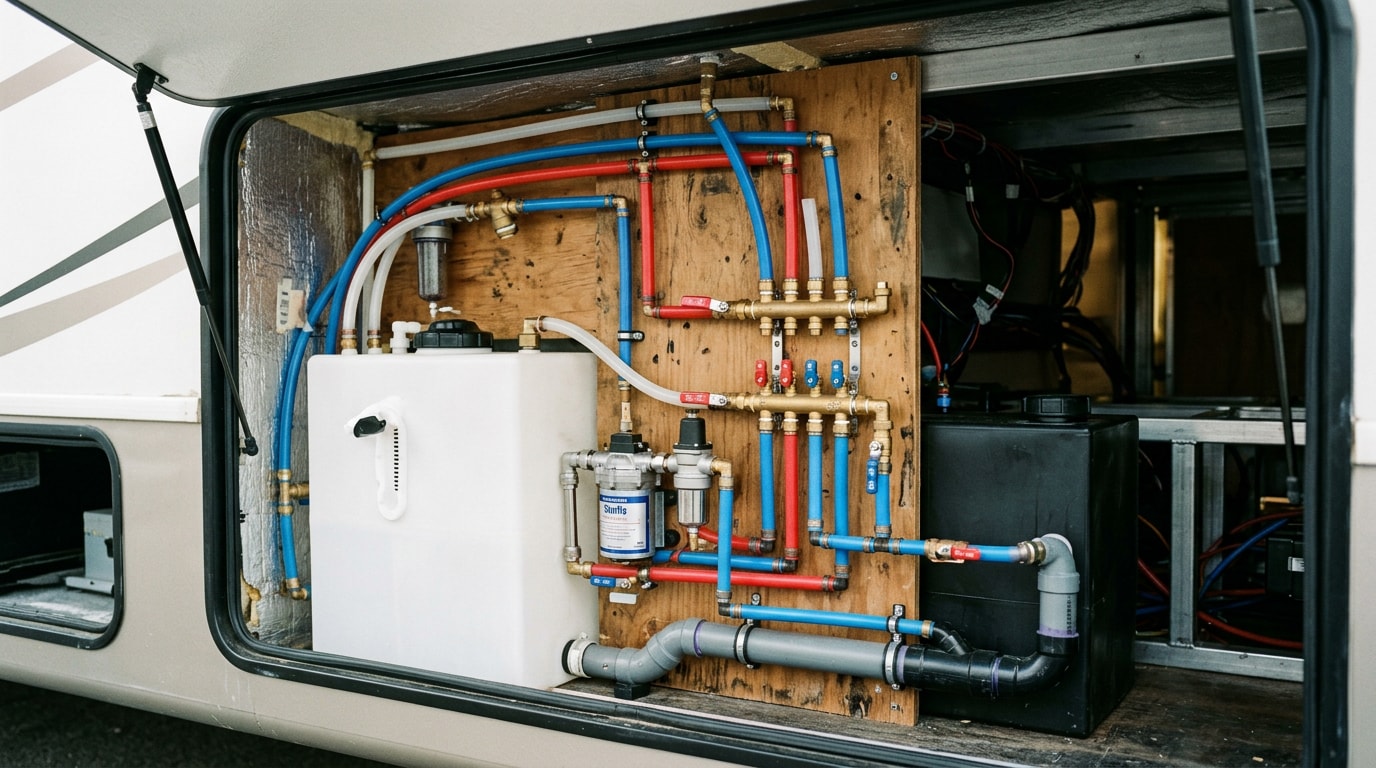
The 12V water pump pressurizes your RV's lines when you're not hooked up to a campground spigot. It's a demand pump: it senses a pressure drop when you open a faucet, then switches on to push water through the system. An inline strainer catches debris before it reaches the pump, and a check valve stops water from flowing backward into the fresh tank.
When you connect to a campground's city water inlet instead, the pump shuts off and outside pressure does the work. A regulator is essential here, since unregulated municipal supply at some parks can spike well past the 40 to 50 PSI range most RV plumbing is built around.
| Mode | Typical Pressure | When It Activates | Pros | Cons |
|---|---|---|---|---|
| 12V Pump Mode | ~40–50 PSI | Boondocking, no hookup | Works anywhere, tank-fed | Limited by battery and tank level |
| City Water Mode | Can exceed 100 PSI unregulated | Connected to campground spigot | Unlimited flow, no pump noise | Needs a regulator to prevent line and fitting damage |
Fresh Water Tank, Water Heater, and Waste Tanks
The fresh water tank stores potable water that feeds both the pump and, indirectly, the water heater. Cold lines run straight to fixtures, while a branch feeds the water heater tank, which then sends hot water out through a separate set of lines.
Wastewater splits into two paths:
- Gray tanks collect drain water from sinks and the shower.
- Black tanks hold toilet waste exclusively.
Keeping these separate matters for sanitation and for how you'll eventually dump and rinse each tank. Vent lines run from both holding tanks up through the roof. They let air escape as tanks fill and prevent vacuum lock, which can slow drains or cause the sulfur smell many RV owners complain about.
Sanitizing the fresh tank periodically is also worth doing. A common emergency water treatment guideline is to add 8 drops of 6% bleach or 6 drops of 8.25% bleach per gallon of water, doubling the dose if the water is cloudy, colored, or very cold , and the EPA's guidance on emergency drinking water disinfection lays out the full table for different volumes.
How to Read an RV Water System Diagram
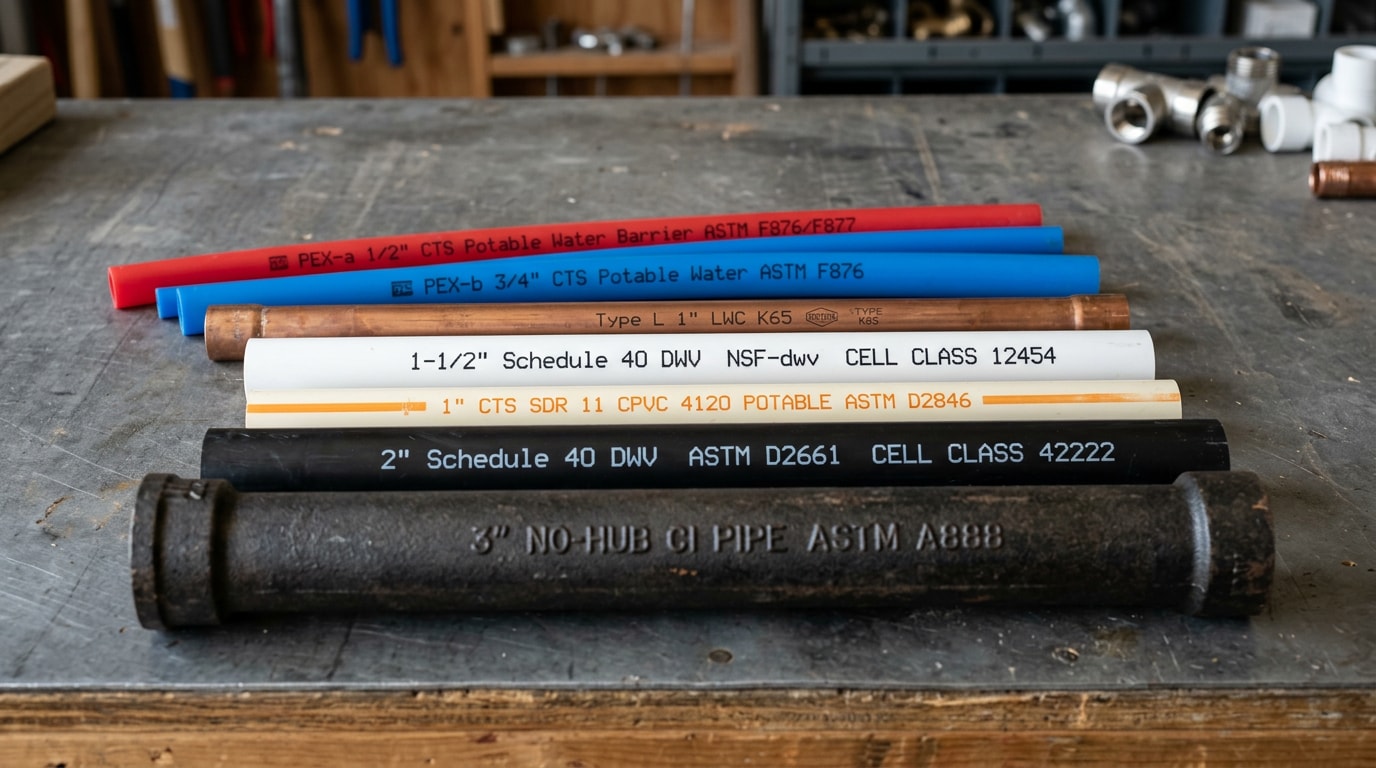
Reading an RV plumbing diagram means tracing one continuous path: source, pump, water heater junction, fixtures, then drain lines. Solid lines typically represent pressurized supply, while dashed lines mark drain or vent paths. Colors usually follow red for hot water supply lines and blue for cold water distribution to fixtures , a convention that's certified under ASTM F877, the standard specification for crosslinked polyethylene (PEX) hot- and cold-water distribution systems , according to SharkBite's PEX technical guide.
Here's the trace in order:
- Source, fresh tank or city water inlet
- Pump/filter, pressurizes and cleans incoming water
- Water heater junction, splits cold supply, returns hot water
- Fixtures, sinks, shower, toilet
- Drain lines, gray and black tank connections

In our service calls around Santa Clara County, a hot-side-only drip at the kitchen faucet is one of the most common RV complaints we see. Tracing the red PEX line backward from the faucet to the water heater junction almost always finds the leak in that segment, not further upstream. If the trace points to a worn fitting or a cracked line you can't reach safely, that's a job for plumbing repair rather than another round of trial and error.
How to Build or Modify Your RV Water System
Planning a new layout or reworking an existing one starts with a few core decisions: where your fresh water input connects, what pump and filter combination fits your usage, and how gray and black tank lines route without crossing.
Bypass valves deserve attention too. They let you skip the water heater tank entirely when winterizing or running antifreeze through the lines. Exact placement and routing vary a lot by RV make and floor plan, so treat any general diagram as a planning framework, not an exact blueprint for your rig. For hands-on help designing or modifying a system, our plumbing installation team serves RV owners throughout Santa Clara, CA and the surrounding South Bay.
Maintenance Checklist for RV Water Systems
A solid maintenance routine keeps small plumbing issues from becoming expensive ones:
- Sanitize the fresh tank roughly every six months.
- Replace inline filters on the manufacturer's recommended schedule.
- Inspect hose connections each season for cracks or loose fittings.
- Always use a pressure regulator on city hookups, even at RV parks you trust.
Winterizing matters more in Santa Clara than many owners expect. December is the coldest month, with an average low of 44°F and high of 59°F, and the cool season runs from late November through mid-February . Nights rarely freeze outright, but a cold snap can still catch an unprotected line off guard. University of California Cooperative Extension master gardeners note that it's worth protecting pipes before a hard freeze, even when temperatures haven't approached freezing yet , which is good general guidance for UC ANR's winter pipe-protection tips and applies just as well to exposed RV lines as to home plumbing.
Draining and blowing out lines before late November is a reasonable buffer for most Bay Area RVers. For seasonal prep or a pre-trip check, a plumbing inspection catches a weak fitting before it fails on the road.
Why Trust This Guide
This guide was put together by the team at Gomez Sewer & Drain, a licensed plumbing contractor serving Santa Clara and the surrounding South Bay. Our technicians field RV and motorhome plumbing calls alongside standard residential work, which is where the hot-side-leak example above comes from. If you'd rather have a professional trace the diagram for you, request a free estimate and we'll walk the system with you before anything gets worse.
FAQ
Can You Drink RV Water?
Yes, RV tank water is safe to drink if the tank has been properly sanitized and filled with potable water. For water that's sat in the tank a while, running it through an inline filter is a smart extra step before drinking.
How Do RV Water Pumps Work?
RV water pumps work on a demand cycle. They stay off until you open a faucet, which causes a pressure drop. The pump senses that drop, switches on, and pressurizes the lines from the fresh tank until the faucet closes again.
How to Winterize Your RV Water System?
Winterizing involves draining the fresh tank and both holding tanks, then blowing compressed air through the lines to clear remaining water. After that, RV-safe antifreeze gets pumped through the system to protect against freeze damage. If you'd rather not do it yourself, our emergency plumbing service team can also handle a late-season winterization call.
How Is RV Plumbing Different From House Plumbing?
A house system pulls from the city main, pressurizes everything automatically, and sends waste to a sewer or septic system without much owner input. An RV system has to do all of that on its own: it stores its own fresh water, switches between tank and city pressure, and separates gray and black waste into onboard tanks that need to be manually dumped.
Do RV Manufacturers Provide Model-Specific Plumbing Diagrams?
Rarely, and almost never for towable trailers. Most manufacturers build to a general layout rather than documenting an as-built schematic for each unit, so a generic diagram is usually the closest reference you'll find unless you contact the manufacturer directly.
Why Does My RV's Gray Tank Smell Bad?
A smelly gray tank is usually a vent or trap issue rather than a tank problem. If the roof vent is blocked or a P-trap has dried out, sewer gas can work its way back into the coach instead of venting outside.
{ "hero": { "prompt": "Photoreal trade photo, no people, underside view of a white RV or travel trailer parked on a driveway showing the exterior water hookup panel: city water inlet, fresh water fill port, and low-point drain valves, clean daylight, shallow depth of field, professional plumbing service context", "alt": "RV exterior water hookup panel with city water inlet and fresh water fill port" }, "inline": [ { "id": "inline-1", "prompt": "Photoreal trade photo, no people, labeled technical cutaway illustration style photo of an RV water system: 12V water pump, fresh water tank, water heater, PEX lines in red and blue, and gray/black waste tanks, clean studio lighting, diagram-style clarity but photoreal textures on components", "alt": "Labeled RV water system diagram showing pump, fresh water tank, water heater, and valve locations" }, { "id": "inline-2", "prompt": "Photoreal trade photo, no people, close-up of RV PEX plumbing lines under a cabinet with red and blue color-coded tubing, a brass check valve, an inline strainer, and a shutoff valve visible, clean bright lighting, crisp focus on fittings", "alt": "Annotated RV plumbing schematic legend showing valve symbols, PEX line colors, and flow direction arrows" } ] }